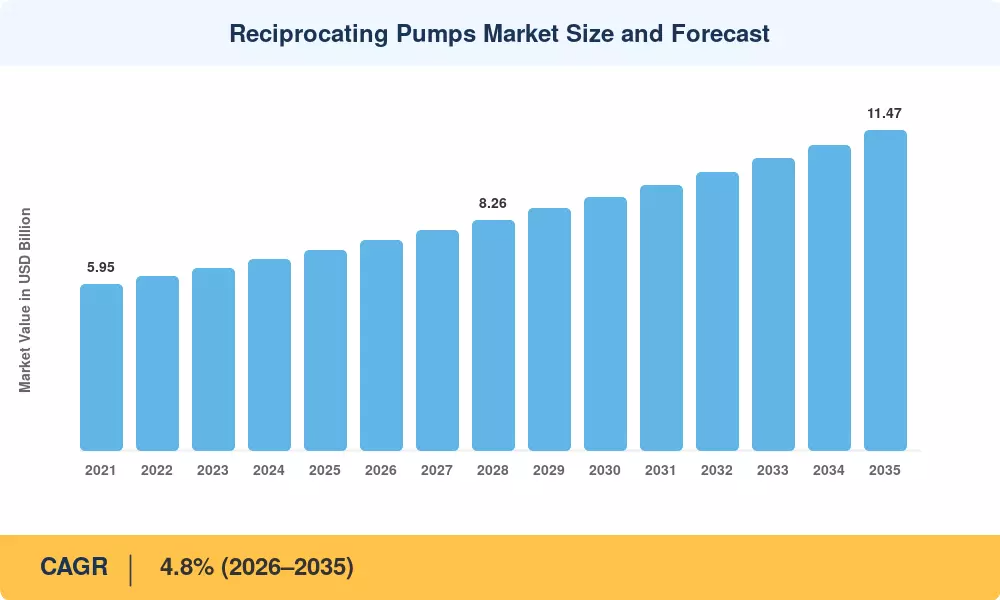
The global Reciprocating Pumps Market reached an estimated USD 7.18 billion in 2025 and is projected to grow from USD 7.52 billion in 2026
NEW YORK, NY, UNITED STATES, July 27, 2026 /EINPresswire.com/ — Market Overview
Reciprocating pumps are positive-displacement pumps that use a piston, plunger, or diaphragm to move fluid through a cylindrical chamber using a back-and-forth (reciprocating) motion. This mechanical action creates alternating pressure fluctuations that draw fluid in through an inlet valve and discharge it through an outlet valve. Their ability to generate exceptionally high pressures—often exceeding 5,000 psi—makes them indispensable for applications requiring precise metering and high-pressure injection, where centrifugal pumps are unable to maintain performance under variable flow conditions. Their versatility spans the handling of low-flow, high-pressure liquids, abrasive slurries, viscous fluids, and chemically aggressive media.
The market’s steady growth trajectory is driven by two powerful catalysts: sustained upstream oil and gas capital expenditure—global E&P spending exceeded USD 580 billion in 2024—and tightening water-treatment discharge standards across OECD nations. Sustained upstream oil and gas capital expenditure and tightening water-treatment discharge standards across OECD nations serve as the two anchor catalysts driving this trajectory, with global E&P spending exceeding USD 580 billion in 2024. The Reciprocating Pumps Market benefits from a demand profile that spans heavy industry, municipal infrastructure, and specialty chemical processing.
Industry trends indicate a decisive shift toward digitalization and intelligent pumping solutions. Legacy, 30-year-old packed-plunger systems are being replaced with digitally monitored, variable-frequency-drive equipped units that reduce energy consumption by 12-18% per duty cycle. The U.S. Department of Energy’s Industrial Efficiency Initiative has committed more than USD 1.2 billion through 2030 to accelerate the replacement cycle with pump-system retrofits in federal facilities. Cloud-connected digital twins that simulate valve wear, packing degradation, and bearing fatigue in real time will transform maintenance from scheduled to predictive—reducing lifecycle costs by an estimated 20%.
Technological developments are rapidly expanding the market’s capabilities. Advanced ceramic plungers, PTFE-lined diaphragms, and duplex stainless-steel valve seats are extending mean-time-between-failure by 30–40% compared with early-2020s benchmarks. Integrating vibration sensors, pressure transducers, and cloud-connected analytics into pump skids enables proactive operational management, reducing unplanned downtime by approximately 25% to 30%. The Reciprocating Pumps Market will reward manufacturers that provide verified carbon-footprint data and energy-efficiency certifications with their equipment as ESG and sustainability reporting pressure increases.
Policy and regulatory influence on the market is substantial and growing. The U.S. 45Q tax credit provides up to USD 85 per metric ton of CO₂ permanently sequestered, incentivizing high-pressure injection system deployment. The EU Industrial Emissions Directive mandates best available technology adoption for chemical and refining installations. The Indian government’s Jal Jeevan Mission aims to provide potable tap water to every rural household with an estimated total outlay of Rs. 3.60 lakh crore (around USD 43 billion), driving demand for reliable dosing and transfer pumps.
The demand outlook remains positive, with decarbonization mandates creating parallel demand in carbon-capture injection and hydrogen compression applications. North America leads at roughly 32% of the market, driven by the Permian Basin and Marcellus Shale. Asia-Pacific is the fastest-growing region with a projected CAGR of 6.2%, driven by Chinese refinery expansion and Indian municipal water programs. Estimated to have a 26% share, Europe is driven by upgrades to meet the stringent EU Industrial Emissions Directive.
📍 Get Free Sample Report for Detailed Market Insights:
https://www.marketresearchfuture.com/sample_request/23560
Market Segmentation
By Type
The reciprocating pumps market is segmented by type into Piston Pumps, Plunger Pumps, and Diaphragm Pumps. Piston pumps account for approximately 38% of the market, reflecting dominance in medium-pressure upstream and midstream operations, serving a broad pressure range (500–3,000 psi) in drilling-mud circulation, pipeline testing, and boiler-feed duties. Their relatively simple construction and wide availability of spare parts make them the default choice in cost-sensitive upstream applications across North America and the Middle East. Plunger pumps are forecast to grow at a CAGR of 5.4% through 2035, supported by intensifying high-pressure well-stimulation and descaling demand, with pressures exceeding 5,000 psi in hydraulic fracturing, CCUS injection, and industrial water-jet cutting. Diaphragm pumps represent an estimated USD 1.94 billion in 2025, favored in corrosive-chemical and pharmaceutical applications where zero-leak operation is critical.
By Application
Application segmentation covers Oil & Gas, Water & Wastewater, Chemical Processing, Power Generation, Pharmaceuticals, and Others. Oil and gas operations account for roughly 34% of end-use demand in the Reciprocating Pumps Market, spanning drilling mud circulation, hydraulic fracturing, and pipeline injection, though its share has gradually declined as water-treatment and pharmaceutical applications expand faster. Water and wastewater treatment holds approximately 22% share, with municipal utilities accelerating pump-fleet modernization and growing at a CAGR of 5.6%. Chemical processing represents USD 1.29 billion in 2025, serving reactor feed and catalyst dosing. Power generation accounts for 12% share, serving boiler feed and ash handling. Pharmaceuticals represent the fastest-growing niche at a CAGR of 6.8%, driven by sterile process dosing and biologics manufacturing.
By Operation
Operation segmentation includes Single-Acting and Double-Acting configurations. Single-acting configurations hold the majority at 55% share because they are simpler, less expensive, and adequate for intermittent dosing and moderate-volume transfer. Double-acting designs are gaining traction at a CAGR of 5.1% where continuous, pulse-free flow is essential—notably in pipeline transport, large-scale desalination feed, and refinery process loops where flow interruptions trigger costly shutdowns.
By Region
Regional segmentation includes North America, Europe, Asia Pacific, South America, and the Middle East and Africa. North America leads at USD 2.30 billion in 2025 revenue, underpinned by shale-basin investment. Asia-Pacific is the fastest-growing regional segment, forecast at a 6.2% CAGR. Europe generates an estimated 26% of global revenue, driven by chemical-sector compliance retrofits.
🛒 You can buy this market report at:
https://www.marketresearchfuture.com/checkout?currency=one_user-USD&report_id=23560
Regional Analysis
North America
North America leads the Reciprocating Pumps Market with roughly 32% share and USD 2.30 billion in 2025 revenue. The United States accounts for 78% of regional share, underpinned by more than 900 active drilling rigs in the Permian Basin and Marcellus Shale, plus an expanding CCUS incentive framework under the 45Q tax credit. Canada grows at a CAGR of 4.5%, driven by oil-sands and mining investments. Mexico contributes USD 0.14 billion, with Pemex refinery rehabilitation adding incremental pump demand through 2027. The region benefits from a robust aftermarket ecosystem and strong OEM presence, with continuous investment in high-pressure injection systems for enhanced oil recovery and CCUS.
Europe
Europe generates an estimated 26% of global revenue, shaped by the EU Industrial Emissions Directive mandating best available technology adoption for chemical and refining installations. Germany leads regional demand at 24% of European share, with BASF, Covestro, and Evonik complexes operating thousands of reciprocating dosing and process pumps. The United Kingdom grows at a CAGR of 4.3%, supported by North Sea decommissioning and water utility upgrades. France contributes USD 0.22 billion, driven by nuclear cooling-circuit pumps. The UK’s Ofwat AMP8 investment cycle (2025–2030) allocates GBP 88 billion to water-network renewal, creating downstream pump procurement. Scandinavia focuses on hydrogen applications, while Eastern European refining supports steady demand.
Asia-Pacific
Asia-Pacific is the fastest-growing regional segment of the Reciprocating Pumps Market, forecast at a 6.2% CAGR. China accounts for 42% of regional share, driven by its petrochemical mega-parks under the 14th Five-Year Plan emphasizing high-quality growth and energy efficiency. India is the fastest-growing major market at a CAGR of 7.1%, with the Jal Jeevan Mission aiming to provide 197 million rural household tap connections by 2028, translating into tens of thousands of chemical-dosing pump installations for water-treatment plants. Japan contributes USD 0.19 billion, driven by specialty chemical and semiconductor fabs. South Korea represents 8% of regional share, with shipyard hydraulic systems supporting demand.
Rest of the World
The Rest of the World segment, encompassing South America and the Middle East and Africa, presents developing market opportunities. Brazil anchors South American demand with 68% of regional share, driven by Petrobras pre-salt deepwater and ethanol processing. Argentina grows at a CAGR of 5.0%, with Vaca Muerta shale development drawing increasing hydraulic-fracturing investment. Saudi Arabia accounts for 40% of Middle East and Africa regional share, with Vision 2030 committing over USD 100 billion to downstream refining and desalination infrastructure. The UAE grows at a CAGR of 5.5%, supported by downstream diversification. The NEOM and Jubail 3B desalination projects require thousands of high-pressure reverse-osmosis feed pumps and chemical-dosing units.
Competitive Landscape / Key Players
The Reciprocating Pumps Market is moderately fragmented, with the top five manufacturers holding a combined 28–34% of global revenue. Key companies operating in this market include Flowserve Corporation, Sulzer Ltd., Grundfos, Dover Corporation (PSG), SPX Flow, IDEX Corporation, Wanner Engineering, Cat Pumps, Danfoss, and Lewa GmbH.
Strategic developments in the market include significant product innovations and industry participation. In July 2026, CDI Products showcased its latest polymer-based pump and valve sealing innovations at the Pump and Valve Asia exhibition in Bangkok to enhance industrial flow control efficiency. The Weir Group successfully integrated its GEHO positive displacement pumps into a major mining project in South Australia in November 2019 to facilitate high-capacity slurry transportation through pipelines. CDI Products participated in the Industrial Valve Summit in Italy in May 2026, presenting advanced sealing technologies designed to optimize pump and valve performance in demanding oil and gas environments.
Competitive differentiation increasingly hinges on pressure rating, metallurgy expertise, aftermarket service networks, and digital monitoring capabilities. Regional specialists in China and India compete aggressively on price in standard-duty segments, while Western OEMs retain dominance in API-certified, high-pressure, and specialty-alloy applications. The transition toward data-driven maintenance allows OEMs to move from traditional equipment sales to outcome-based contracts, significantly enhancing customer lifetime value.
Latest Industry News & Developments
Recent industry developments highlight the ongoing transformation of the reciprocating pumps market toward digitalization, sustainability, and advanced material applications. In July 2026, CDI Products showcased its latest polymer-based pump and valve sealing innovations at the Pump and Valve Asia exhibition in Bangkok to enhance industrial flow control efficiency. This development reflects the industry’s focus on improving reliability and reducing maintenance requirements in demanding pumping applications.
In May 2026, CDI Products participated in the Industrial Valve Summit in Italy, presenting advanced sealing technologies designed to optimize pump and valve performance in demanding oil and gas environments. The company’s presence at major industry events underscores the growing importance of sealing and material innovations in extending pump life and reducing fugitive emissions.
The global low-emissions hydrogen production is projected to grow from less than 1% of total production today to approximately 4% by 2030, based on committed projects. Diaphragm compressors and reciprocating boosters are essential for hydrogen fueling stations operating at 350–700 bar, creating new demand channels for the Reciprocating Pumps Market beyond traditional fossil-fuel-linked sectors.
Market Challenges & Opportunities
Key restraints facing the reciprocating pumps market include high maintenance and spare parts cost, with pump efficiency degrading by 10–25% due to mechanical wear before replacement is necessary. Inadequate maintenance practices in industrial settings contribute to annual global losses of approximately USD 222 billion, significantly impacting total cost of ownership. Competition from advanced centrifugal technologies, which represent approximately 66.5% of the global pump market share in 2025, limits the reciprocating market’s expansion into more standardized industrial fluid-handling applications. A skilled-technician shortage, particularly in emerging economies where a significant portion of the global population resides, complicates preventive maintenance cycles. Volatile raw-material pricing and fossil-fuel demand-peak scenarios further moderate growth.
Emerging opportunities in the market are substantial and diverse. Carbon capture, utilization, and storage injection systems present a significant opportunity, with the global CCUS project pipeline expanding significantly as nations prioritize decarbonization. High-pressure reciprocating pumps rated for supercritical CO₂ service are critical for these injection systems. Smart-pump and predictive-maintenance platforms integrating vibration sensors, pressure transducers, and cloud-connected analytics enable proactive operational management, reducing unplanned downtime by approximately 25% to 30%. Emerging-market municipal water programs, with Africa requiring an estimated USD 50 billion in annual water-infrastructure investment to achieve SDG 6 by 2030, create demand for compact, solar-powered reciprocating dosing systems.
Future potential lies in hydrogen economy compression demand, with diaphragm compressors and reciprocating boosters essential for hydrogen fueling stations operating at 350–700 bar. Pharmaceutical and biotech precision dosing, with the global biopharmaceutical market valued at over USD 500 billion in 2025, requires ultra-precise reagent metering where reciprocating diaphragm pumps are preferred. Digitalization and autonomous pump operations, with industrial IoT penetration in rotating and reciprocating equipment expected to exceed 45% by 2032, will transform maintenance from scheduled to predictive. Material science advances, including advanced ceramic plungers and duplex stainless-steel valve seats, are extending mean-time-between-failure by 30–40%, improving the total-cost-of-ownership equation.
To explore more market insights, visit us at:
https://www.marketresearchfuture.com/reports/reciprocating-pumps-market-23560
Final Market Summary
The reciprocating pumps market is positioned for steady growth through 2035, driven by sustained upstream oil and gas investment, municipal water infrastructure development, and expanding CCUS and hydrogen applications. The projected valuation of USD 11.47 billion reflects sustained demand across oil and gas, water and wastewater, chemical processing, and pharmaceutical sectors, with the market transitioning from legacy mechanical systems to digitally monitored, energy-efficient platforms.
The medium-term growth outlook remains positive, with the market registering a CAGR of 4.8% during the forecast period. North America will continue to maintain market leadership through shale-basin investment and CCUS incentives, while Asia-Pacific emerges as the fastest-growing region driven by Chinese refinery expansion and Indian municipal water programs. The ongoing development of smart-pump platforms, advanced materials, and energy-transition applications will continue to expand market possibilities.
Long-term industry potential extends beyond the current forecast horizon. The energy-transition diversification, with hydrogen and CCUS together accounting for over 15% of cumulative emission reductions needed by 2050, will translate into sustained pump-infrastructure investment. ESG and sustainability reporting pressure will reward manufacturers that provide verified carbon-footprint data and energy-efficiency certifications. Manufacturers that successfully develop digitally enabled pumping solutions, invest in CCUS and hydrogen-ready technologies, and establish service networks in emerging markets will capture substantial value in this evolving market. The transformation of reciprocating pumps from basic mechanical devices to intelligent, data-enabled process-critical equipment represents a fundamental advancement in industrial fluid handling, enabling safer, more efficient, and increasingly sustainable operations across sectors.
More Related Reports from MRFR Library:
Sealless Magnetic Drive Pump Market: https://www.marketresearchfuture.com/reports/sealless-magnetic-drive-pump-market-22684
Mobile Water Treatment Market: https://www.marketresearchfuture.com/reports/mobile-water-treatment-market-22903
Material Testing Market: https://www.marketresearchfuture.com/reports/material-testing-market-23042
Industrial Pump Market: https://www.marketresearchfuture.com/reports/industrial-pump-market-23053
Industrial Oxygen Market: https://www.marketresearchfuture.com/reports/industrial-oxygen-market-23056
Industrial Brakes Market: https://www.marketresearchfuture.com/reports/industrial-brakes-market-23058
Water Testing Analysis Market: https://www.marketresearchfuture.com/reports/water-testing-analysis-market-23304
Hydraulic Elevators Market: https://www.marketresearchfuture.com/reports/hydraulic-elevators-market-23309
Industrial High Shear Mixers Market: https://www.marketresearchfuture.com/reports/industrial-high-shear-mixers-market-23418
Industrial Laundry Market: https://www.marketresearchfuture.com/reports/industrial-laundry-market-23420
Larry Wilson
WantStats Research And Media Pvt. Ltd.
+1 855-661-4441
email us here
Legal Disclaimer:
EIN Presswire provides this news content “as is” without warranty of any kind. We do not accept any responsibility or liability
for the accuracy, content, images, videos, licenses, completeness, legality, or reliability of the information contained in this
article. If you have any complaints or copyright issues related to this article, kindly contact the author above.

Media gallery